Fes News Media Morocco & Fez-Meknes Independent English News Portal — 24/7 Coverage


- An official Algerian document reveals a glaring contradiction between the official rhetoric of Algeria’s military establishment and its practices on the ground,...
- While various Moroccan cities—from Rabat to Casablanca, Fez, Agadir, Tangier, Marrakech, Oujda, and even remote villages—have witnessed dozens of spontaneous an...
An official Algerian document reveals a glaring contradiction between the official rhetoric of Algeria’s military establishment and its practices on the ground, particularly concerning the Palestinian issue that dominates its media and political discourse. While various Moroccan cities—from Rabat to Casablanca, Fez, Agadir, Tangier, Marrakech, Oujda, and even remote villages—have witnessed dozens of spontaneous and organized solidarity rallies, with public squares filling with Palestinian flags and chants condemning the aggression, a different reality is exposed by an internal document issued by the Algerian Ministry of the Interior. Dated August 1, 2025, and numbered 9589, the document explicitly rejects a request to authorize a solidarity march with the Palestinian people, called for by a group of Algerian political parties for August 7. The justification provided is that the law does not permit demonstrations in open spaces such as squares and streets, and that any such activity must be confined to enclosed halls.
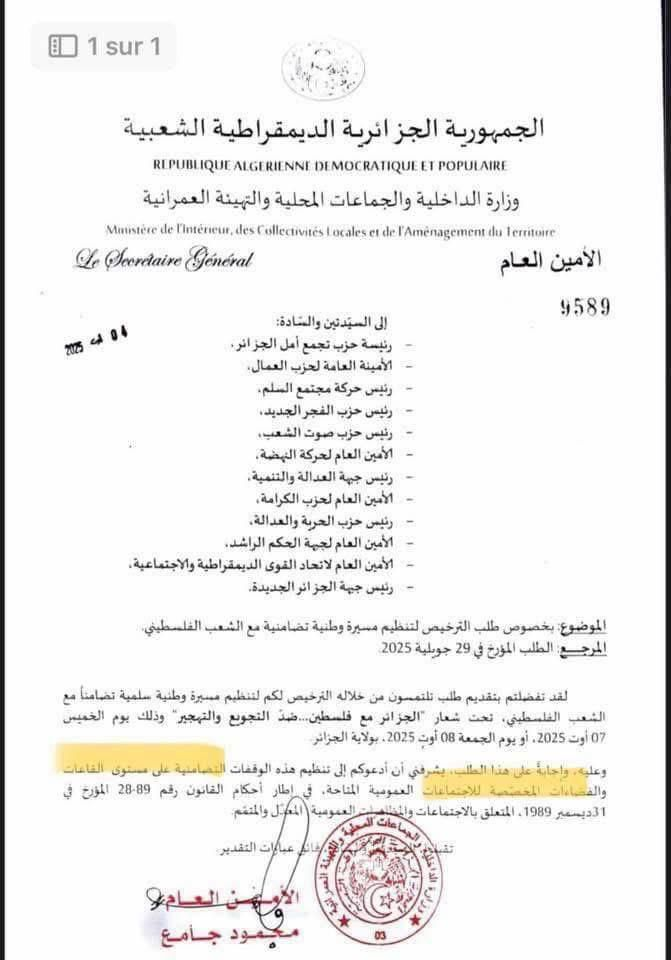
This blatant refusal serves as a stark example of the political suffocation imposed by the Algerian regime, which extends even to forms of solidarity that are supposedly part of what it deems “national constants.” Even when it comes to Palestine—an issue the Algerian state exploits in its foreign policy and uses as a bargaining chip in international forums—its expression within the country is only permitted under the conditions set by the army and its security apparatus, within enclosed halls, and under the direct supervision of the Army Chief of Staff, General Saïd Chengriha. The irony is that the parties that requested the permit are not opposition groups; they are largely considered to be aligned with the regime’s own circles. Yet, they were not allowed to organize this symbolic event, reflecting the extent of the security obsession and political repression in a country run by the military with an iron fist.
In contrast, the picture is starkly different in Morocco, where the authorities have not prevented any popular or civic expression of solidarity with Palestine. In fact, over the past few months, more than fifty solidarity vigils and demonstrations have been recorded across various regions of the kingdom. These events, organized by political, union, human rights, and civil society bodies, saw a remarkable presence of youth, students, and ordinary citizens in the streets of Morocco, holding clear banners in support of the Palestinian people and condemning the aggression. The difference here is striking between a country that allows its people to freely express themselves on a just humanitarian cause and another that distrusts its own citizens even when they are raising the Palestinian flag.
This scenario confirms that the Algerian military regime, which claims to support “Palestine whether it is the oppressor or the oppressed,” in reality only allows a Palestine under its direct tutelage and only to the extent that it serves its propaganda agenda. But if the Algerian people wish to express their solidarity independently and spontaneously, it becomes forbidden and is immediately classified as a “security threat.” In Algeria, solidarity is only permitted with the general’s prior consent, and the Palestinian flag is not raised in public unless blessed by the military barracks. This transforms solidarity from a noble human expression into a mere security procedure subject to surveillance, and anything not organized according to the regime’s rules is met with prohibition and suppression. Ultimately, it seems that for the Algerian regime, Palestine is not the cause of a people struggling for their rights, but merely a pretext for power, to be exploited as needed.