فاس نيوز ميديا جريدة الكترونية جهوية تعنى بشؤون و أخبار جهة فاس مكناس – متجددة على مدار الساعة

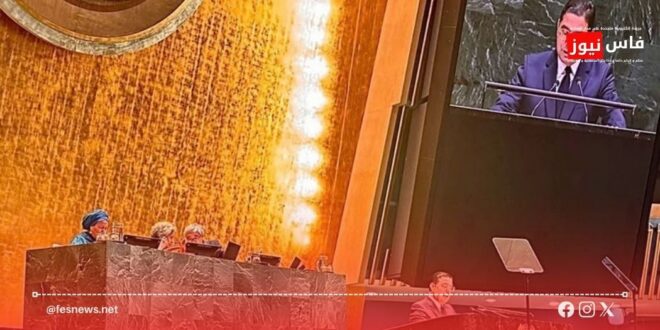
New York – Minister of Foreign Affairs, African Cooperation and Moroccans Abroad, Nasser Bourita, presented Morocco’s vision for the settlement process of the Sahara issue before the United Nations General Assembly on Tuesday, outlining six principles that he said would frame the next stage, in a context he described as marking a shift in the course of the issue following the adoption of Security Council Resolution 2797 in 2025.
During his speech on behalf of Morocco at the 81st session of the United Nations General Assembly, Bourita said Rabat considers that the process of settling the issue has entered a new phase, relying in this regard on what he described as the momentum initiated by King Mohammed VI and on developments linked to the Security Council resolution.
According to the minister’s presentation, Morocco’s vision is based on six main principles:
Adopting the autonomy proposal under Moroccan sovereignty as the framework for a solution from Morocco’s perspective.
Limiting the process to political negotiations under United Nations auspices and on the basis of the Moroccan autonomy initiative.
Emphasizing the responsibility and commitments of the parties concerned as interpreted by Morocco in light of Resolution 2797.
Rejecting the continuation of the status quo and pushing for the continuation of the political process.
Emphasizing the need to respect the ceasefire and Security Council resolutions.
Rejecting the continuation of the situation of the populations of the Tindouf camps, while calling for the issue to be addressed from the perspective of international law and international humanitarian law.
By contrast, Security Council Resolution 2797 (2025), according to United Nations documents, provides for the continuation of the political process with the aim of reaching a just, lasting and mutually acceptable political solution, while extending the mandate of the United Nations Mission for the Referendum in Western Sahara (MINURSO) until October 31, 2026.
On the economic and social front, Bourita said Morocco was continuing to implement development projects in the southern provinces, covering infrastructure, university education, healthcare, airports and other sectors.
The minister also linked participation in the legislative elections scheduled for today, Wednesday, to what he described as strengthening the political representation of the populations of the region, referring to the electoral process taking place in Morocco.
Bourita’s statements come within the framework of the ongoing United Nations debate over the Sahara issue, as the United Nations continues its efforts to find a political settlement to the conflict in accordance with Security Council resolutions and the process sponsored by the international organization. The parties’ positions regarding the nature of the final solution and its reference framework remain at odds within the UN-led process.
Sahara marocain.. Bourita présente devant l’ONU six principes pour le règlement définitif
New York – Le ministre des Affaires étrangères, de la Coopération africaine et des Marocains résidant à l’étranger, Nasser Bourita, a présenté mardi devant l’Assemblée générale des Nations Unies la vision du Maroc concernant le processus de règlement de la question du Sahara, en définissant six principes qui, selon lui, encadrent la prochaine étape, dans un contexte qu’il a décrit comme marquant un tournant dans l’évolution du dossier à la suite de l’adoption par le Conseil de sécurité de la résolution 2797 en 2025.
Lors de son discours au nom du Maroc devant la 81e session de l’Assemblée générale des Nations Unies, Bourita a déclaré que Rabat considère que le processus de règlement de la question est entré dans une nouvelle phase, s’appuyant à cet égard sur ce qu’il a décrit comme la dynamique impulsée par le Roi Mohammed VI ainsi que sur les développements liés à la résolution du Conseil de sécurité.
Selon la présentation du ministre, la vision marocaine repose sur six principes fondamentaux :
Adopter la proposition d’autonomie sous souveraineté marocaine comme cadre de règlement du point de vue du Maroc.
Limiter le processus à la négociation politique sous l’égide des Nations Unies et sur la base de l’initiative marocaine d’autonomie.
Souligner la responsabilité et les engagements des parties concernées tels que les interprète le Maroc à la lumière de la résolution 2797.
Refuser la poursuite du statu quo et œuvrer à la poursuite du processus politique.
Insister sur la nécessité de respecter le cessez-le-feu et les résolutions du Conseil de sécurité.
Refuser la poursuite de la situation des populations des camps de Tindouf, tout en appelant à traiter le dossier à la lumière du droit international et du droit international humanitaire.
En revanche, la résolution 2797 (2025) du Conseil de sécurité, selon les documents des Nations Unies, prévoit la poursuite du processus politique afin de parvenir à une solution politique juste, durable et acceptable par les parties, tout en prorogeant le mandat de la Mission des Nations Unies pour l’organisation d’un référendum au Sahara occidental (MINURSO) jusqu’au 31 octobre 2026.
Sur le plan économique et social, Bourita a indiqué que le Maroc poursuivait la mise en œuvre de projets de développement dans les provinces du Sud, couvrant notamment les infrastructures, l’enseignement universitaire, la santé, les aéroports et d’autres secteurs.
Le ministre a également établi un lien entre la participation aux élections législatives prévues aujourd’hui, mercredi, et ce qu’il a décrit comme le renforcement de la représentation politique des populations de la région, en référence aux échéances électorales que connaît le Maroc.
Les déclarations de Bourita interviennent dans le cadre du débat continu au sein des Nations Unies sur la question du Sahara, alors que l’Organisation poursuit ses efforts en vue de parvenir à un règlement politique du conflit conformément aux résolutions du Conseil de sécurité et au processus parrainé par l’organisation internationale. Les positions des parties concernant la nature de la solution finale et ses références demeurent divergentes dans le cadre du processus onusien.
Source : Fès News Media