فاس نيوز ميديا جريدة الكترونية جهوية تعنى بشؤون و أخبار جهة فاس مكناس – متجددة على مدار الساعة

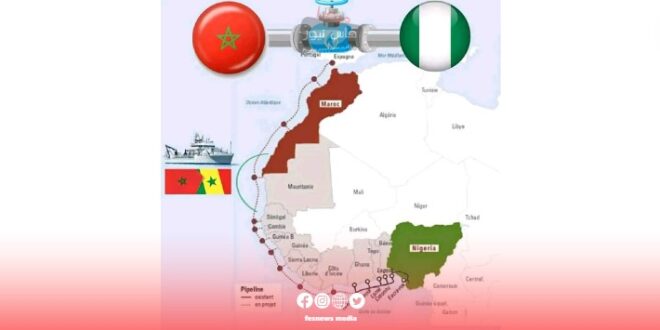
Rabat – The Morocco-Nigeria Gas Pipeline project has seen significant development with the confirmation of its technical and economic viability, a reduction in its cost to $20 billion (USD) following logistical optimizations, and a financial structure based on independent geographical segments, as explained by Mohamed Benzaria, CEO of ONHYM Midstream Co. (OMCO), in an exclusive interview.
Benzaria, who heads the subsidiary of the National Office of Hydrocarbons and Mines (ONHYM) responsible for natural gas transportation and storage, confirmed that the detailed engineering studies for the project were completed in April 2024, confirming its technical and economic feasibility. He also noted that the necessary political agreements with the concerned countries have been concluded, adding: “We have finalized the political agreements and confirmed the commercial model. Now, what remains is the field execution, which constitutes the real operational challenge.”
Regarding the cost, Benzaria reported that the initial amount of $25 billion has been reduced to approximately $20 billion, resulting from logistical improvements and negotiations with implementation contractors. As for the structure, the project will be managed through a main holding company, with subsidiaries responsible for independent geographical segments during the construction phase, to ensure efficiency and flexibility.
The project is divided into three main segments:
- The Southern Segment: Extending from Nigeria to Côte d’Ivoire;
- The Central Segment: Covering the area from Côte d’Ivoire to Senegal;
- The Northern Segment: Connecting Senegal to the Maghreb-Europe Gas Pipeline (GME), which in turn links to the European network.
Benzaria explained that “each segment is commercially independent and can be justified separately,” allowing for flexible financing. In this context, the Project Finance model is preferred for the majority of the route, while Public-Private Partnerships (PPP) are an option for specific segments, such as the section connecting the GME to Mohammedia. According to the CEO, this model ensures the project’s profitability and economic stability, as detailed in the attached video.
Concerning the anticipated benefits, Benzaria stressed that the gas pipeline, which will pass through 13 countries and serve nearly 400 million people, represents a continental project that goes beyond energy supply to include comprehensive economic development. He emphasized the importance of the “local content” principle, which focuses on identifying African companies capable of executing tasks, developing local skills, and enhancing training in specialized professions. Benzaria stated: “One of the key focuses is that this gas pipeline must be implemented for the benefit of Africans and by Africans,” reflecting a commitment to making the project an instrument for inclusive and sustainable development.